

Principle 8: Physical and Online Environments Promote Wellbeing and Minimise Harm
This chapter looks at the importance of managing and documenting risks in physical and online environments to reduce harm to children.
In this Chapter, you will learn:
The purpose and importance of safety and risk planning
Basic risk factors and a scenario for evaluation of risks
High risk activities and critical incidents
Some risks in an online environment
What are your and your organisation's responsibilities in promoting well-being & minimising harm and abuse?
Your organisation is responsible for;
Providing a safe place for all
Ensuring that risk management strategies are in place
Training about expectations of online behaviour
You, as a child facing team member are responsible for;
Promoting safety and wellbeing
Attending training
Inputting to, and complying with risk management strategies
Managing safety & risk
We can’t just hope for a safe program.
Each program includes potential risks that will need managing. All leaders are responsible for the safety management process.
You’ll need to plan your programs with your relevant leaders and identify the likelihood of risks, their consequences and how you will mitigate them.
ChildSafe considers risk more holistically than just in the context of child abuse.
Identifying risks
Assessing risks
What types of risks do we consider when planning activities
Physical injury
Allergic reactions
Danger to life
Emotional harm
Risk of abuse
It’s vital to think about safety continuously and work towards a culture of safety and care because all of us are responsible for the safety and care of children.
Your program and activity choices need to be made keeping the participant group’s capability and risk profile in mind.
ask your leader to help you plan
take into account age appropriateness
have clear boundaries and rules to ensure participants can engage in activities safely
be willing to drop an activity if you sense it’s not working safely, or is making participants feel angry or isolated
put in extra planning and support measures when an activity has extra challenges
Higher Risk Activities
Higher Risk Activities come with associated or elevated risk that should be evaluated from several angles before proceeding.
You must:
Not supervise higher-risk activities without relevant qualifications
Have organisational approval to proceed
Be aware ALL participants are capable of participating in the activity by providing the necessary support
Be aware that a venue is fit and conditions acceptable for a planned higher-risk activity
While these topics will not be dealt with in this training, important questions need to be asked for any activity planning where these occur as part of your duty of care.
Examples include
Health and First Aid
Food handling
Driving and transportation
Swimming
Outdoor activities
Persons with disabilities
Incidents
You have a duty of care to ensure that all vulnerable people in your care are kept safe from harm and from all reasonably foreseeable risk of injury.
No matter how minor an incident;
You MUST report it to your Leader
You may need to complete an Incident Report
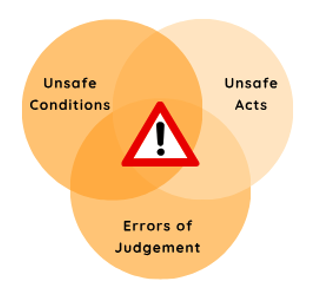
Most incidents are the result
of these three types of causes,
often in combination:
Keeping in mind the 3 most common incident causes:
unsafe conditions
unsafe acts
errors of judgement,
Think about a program in which you might be involved in or lead:
(Write down your answers in a notebook.)
What could go wrong?
What types of risks do you need to consider when planning a program?
What context-specific issues might be relevant to your program?
Incidents may include:
Accidents
Property damage
Near misses
Major disruptions to the program
Child (or vulnerable person) abuse issues
Critical Incidents
A critical incident is a serious situation that is far beyond what is normal or expected.
A critical incident is a serious situation that is far beyond what is normal or expected. It is possible that a critical incident may occur during your program or event.
Being likely to require assistance from outside your immediate program team, you need to be prepared for such a situation.
Incidents
Incident (Noun)
An undesired event that results or could have resulted in harm, damage or loss.
Most incidents are cause by these three conditions
Unsafe conditions
Unsafe acts by participants
Errors of judgement on the part of the leader
A Critical incident is an event where the consequences are severe, traumatic or require an emergency response.
Serious vehicle accident, loss or a significantly injured participant, a natural tragedy or bush fire, significant violence between participants, sexual assault or a participant engaging in self harm, or a suicidal participant. (attempted or actual suicide)
How we respond is really important
How to respond
Ensure that the children and vulnerable people feel safe.
Provide for their immediate needs.
Communicate with the children and vulnerable people.
Reunite them with their family as soon as practical
Protect them from exposure to the media.
How we respond to a critical incident is really important.
Here’s how you should care for children and vulnerable people if a critical incident does occur:
Ensure that those in your care feel safe – remove them from the danger.
Accept regressive behaviour e.g. thumb-sucking, tears, cuddles
Protect them from exposure to the media
Involve the person – give them simple tasks or activities to normalise the situation
Provide for their immediate needs – food, water, toilets
Communicate with them – keep them informed
Yes, that's right, all these conditions could create risks for injury, accident or other harm in this situation.
A range of risks leading to injury, accident or other critical incidents, could include the following and more:
Bodily impact into each other, accelerated by rain
Head injury and/or concussion .
Bleeding from impact or injury
Injury sustained from shoes, while jumping
Eye injury sustained from wearing glasses
Torn ligament
Effect from allowing any age interact at once
Remember:
Do not leave any vulnerable person alone at any time in a critical incident, until reunited with their family.
Follow your Team Leader’s directions
Online Safety
Online interactions can place children and vulnerable people at risk of cyberbulling, unwanted contact or grooming, exposure to inappropriate or harmful content.
Your organisation's policies, procedures and code of conduct should address both physical and online environments, including:
Guidance on boundaries for online interactions between staff, volunteers and children
Social media and photography guidelines
Communication via social media, texting and emails
Information privacy
Access to the internet or devices during your programs or activities
Children and inappropriate or harmful content
Children may discover online harmful content online unintentionally, or they may go looking for it. Children may be exposed to pornography, sexual images, violence, hate speech, bullying and abuse.
Did you know?
That 44% of children (age 9-16 years) had seen sexual images in the past month
Online Safety is another topic we aren't going to cover in detail in this course, however,
as a Team Member, you should have a basic idea of online risks and/or contribute to the risk assessment process.
How can you help children and vulnerable people to be safe online?
Encourage them to ask for help if they see something online that makes them feel worried or uncomfortable
Encourage them to be kind to others, being mean online is not ok
Teach them to be careful with their private information
Educate them about being safe online
Enable security and privacy settings on devices
Encourage them to be wise, not everything or everyone online should be trusted
To learn more about online safety follow this link to the eSafety website